About Giant Loop


David Wachs, Giant Loop designer
David Wachs designed the Giant Loop™ Saddle Bag for personal use on long-
distance off-road adventures. CLICK HERE for PDF Bend Bulletin article.

Sign up for Giant Loop Email: Tips, Deals, News
For Email Marketing you can trust


For more video, pics and updates, visit our blog.

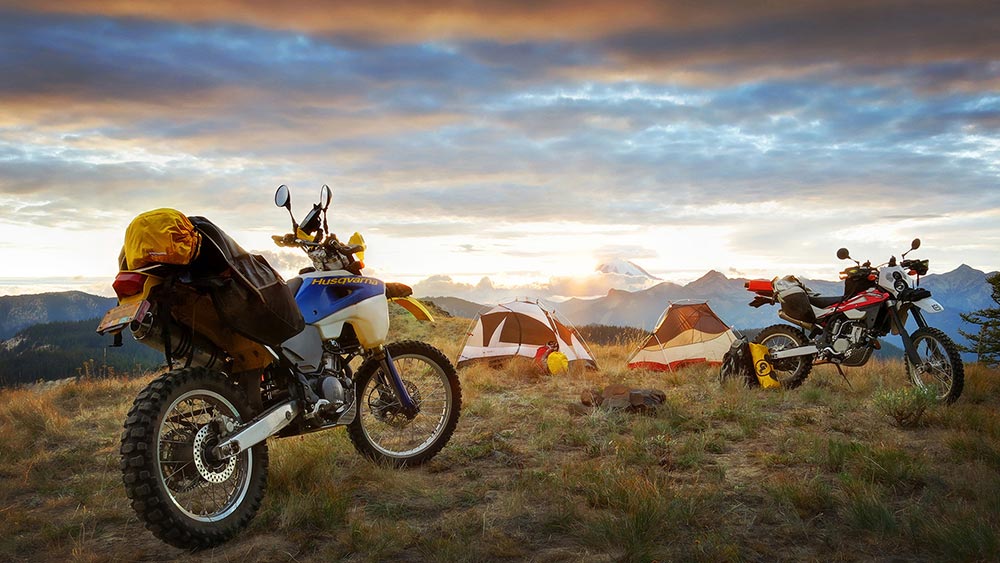
The idea for long-distance, multi-day rides on dirtbikes actually came from our friend Josh Hale who told us stories of his adventures out of Nevada City, CA as a kid back in the late ‘70s and early ‘80s. They put all their junk in backpacks and suffered through till they found a campsite.

Another inspiration was a group of dusty old-timers Dave encountered on the old Santiam Wagon Trail just west of Sisters, Oregon sometime around 1994. These wily veterans were on XR 250s and their leader was a quite large man on a suffering DR250. To haul their gear, they use an interesting collection of military baggage, backpacks and duffel bags lashed to the motorcycles. These friendly fellas were heading west over the Cascades after spending a few days at Christmas Valley Sand Dunes and still had 120 miles to get home to Stayton, OR. We thought that was burly, and we were kind of jealous of their trip.

Dave started out with some homemade ‘doggie backpack-style’ saddle bags custom sewn for his ‘95 RXC 620. The maiden voyage on this set up was down in Cali on a trip from Ridgecrest into Death Valley up Golar Wash.

“Everything was working OK,” says Dave. “The other guys’ kits carried quite a bit more gear, but mine was very minimal and my bike handled much more sporty than the others, for sure. Tom Dillenbeck and I swapped bikes (he was on an early 640 ADVENTURE), and that’s when I realized the potential of truly long-distance rides with that huge 7.5-gallon tank. On the second day over Lippencott headed for the Saline, my set up slipped onto the pipe. I stopped to see molten number plate plastic dripping onto my bike’s swing arm. I got to camp and Ezra found a California Centennial license plate that I wired onto the bike as a heat shield. That hillbilly fix got me through the trip, but it wasn’t pretty.”


HOC
Harold Olaf Cecil joined Dave on an early Giant Loop, constantly fiddling with a
rafting dry bag lashed to a heavy custom rack and road bike saddle bags that had
to be held out of the way to kick start the bike.


Several other versions were built, tested and worked fine but there were still three bags: Two on the sides and a duffel lashed to the stock KTM rack on the back of the bike. Stuffing gear into bags and strapping them to the bike took too much time and required constant attention to make sure nothing was shifting around. The KTM’s steel subframe cracked in a couple places and needed gussets to repair. Our buddies’ racks were all bent, cracked or worse and none of us left town without backup straps (not bungies) to make those inevitable back country repairs. It became rather obvious that unless we were just going to putt-putt across the desert, we needed a more secure system.

“One morning at camp I was packing my kit and it occurred to me that the solution was a continuous volume connecting all three spaces into one,” says Dave. “I didn’t need to stuff my sleeping bag into a bag and lash another bag on, it simply needed to be one space – just like my backpacks.”

The first of these designs worked flawlessly (although it was a bit small), and Dave put several thousand miles of hard riding on it testing the concept. The second and third versions were much better space-wise, but the concept had proven itself and every trip Dave took illustrated the challenges his friends (like Harold) were dealing with by not having the convenience of our system.

The final version of this idea has many more trips on it, and we are confident that if you embrace the “go light, go fast” theory of off-road adventure riding, you will enjoy the tight, low-riding weight distribution of our system. Dave has been out for seven-day trips and has yet to find himself wanting more space or more stuff. Think about it: You are going to need fuel almost everyday, and it’s not like you are traversing the Gobi Desert for the first time ever (although it would probably allow you to do a trip like that). Once you really pare it down to the essentials, you realize that truly, “less is more.”

Ride while you can!

Dave Wachs & Harold Olaf Cecil

giant loop llc